The Encampment Movement against Evictions and Gentrification
:A Report from Madrid and Barcelona

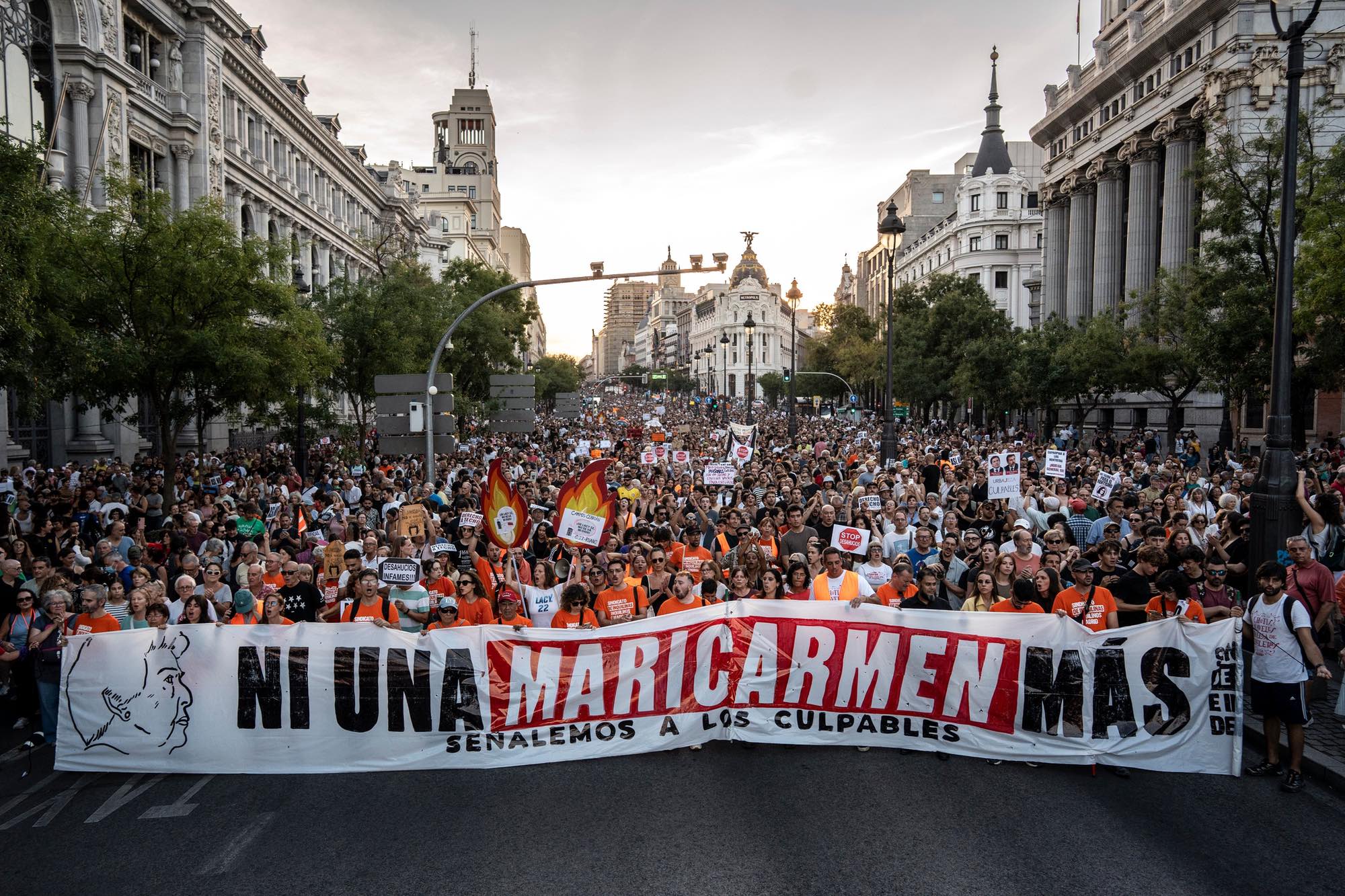
On September 23, 2026, Spanish authorities violently evicted Maricarmen Abascal, a disabled 87-year-old woman, from her home in Madrid following her long judicial struggle with a real estate company named Urbagestión. She had lived there for 70 years, but could not afford the latest rent increases. In response, 10,000 people took the streets in protest that day. Three days later, a much larger demonstration established an encampment in the Puerta del Sol square, which had been the site of the 15-M movement in 2011, itself the trigger for the Occupy movement in the United States.
Maricarmen Abascal passed away on October 7 as a consequence of the stress resulting from the eviction. Protesters have continued to occupy the squares in many cities across the Iberian Peninsula. A general strike has been called for November 11.
Here, our correspondents in Madrid and Barcelona offer a view from within the movement against evictions and gentrification that has spread across Spain and Catalunya.
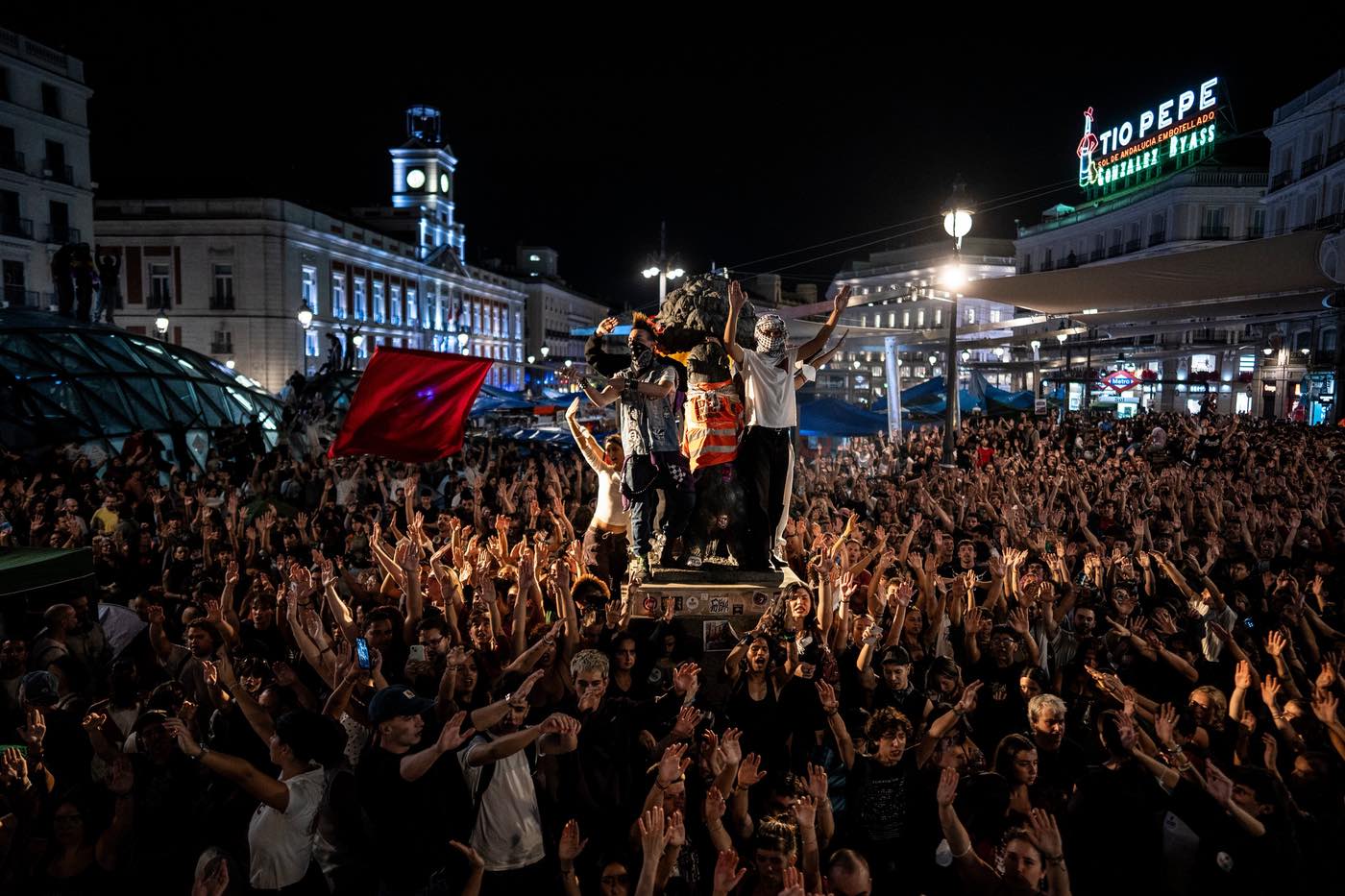
Anti-fascists gather to defend the housing encampment in Madrid’s Plaza del Sol, 2026.
The housing movement in Spain has a long and complex history. For any period that we might choose as a point of departure, there always exists a prior precedent that could serve just as well—so where we begin depends on how we wish to make sense of what is happening today, how we wish to narrate this story that is still being written in the streets. What follows, then, is an attempt, however insufficient and incomplete, to tell this story, in hopes that you can learn or be inspired by something from it and, in this way, become part of this story and build upon it wherever you live.
We could perhaps begin with the 15-M movement, which erupted a decade and a half ago as part of the sequence of uprisings that unfolded across the globe in 2011. Encampments spread across Spain much as they have today, full of people clamoring for “real democracy.”
Whereas elsewhere, repression often put these movements to an unresolved end, in Spain, this movement culminated with the formation of several far-left political parties, including Podemos, as well as strong municipalist movements in Madrid, Barcelona, and other cities. Today, these parties lie in ruins, while the municipalists have largely lost whatever power they once held. Ultimately, much like Occupy Wall Street and the Arab Spring, the true legacy of this sequence remains ambiguous, contested, and open to interpretation. Perhaps the 15-M movement is not the beginning of the story we’re telling, but simply the ruins from which the current one is being told.
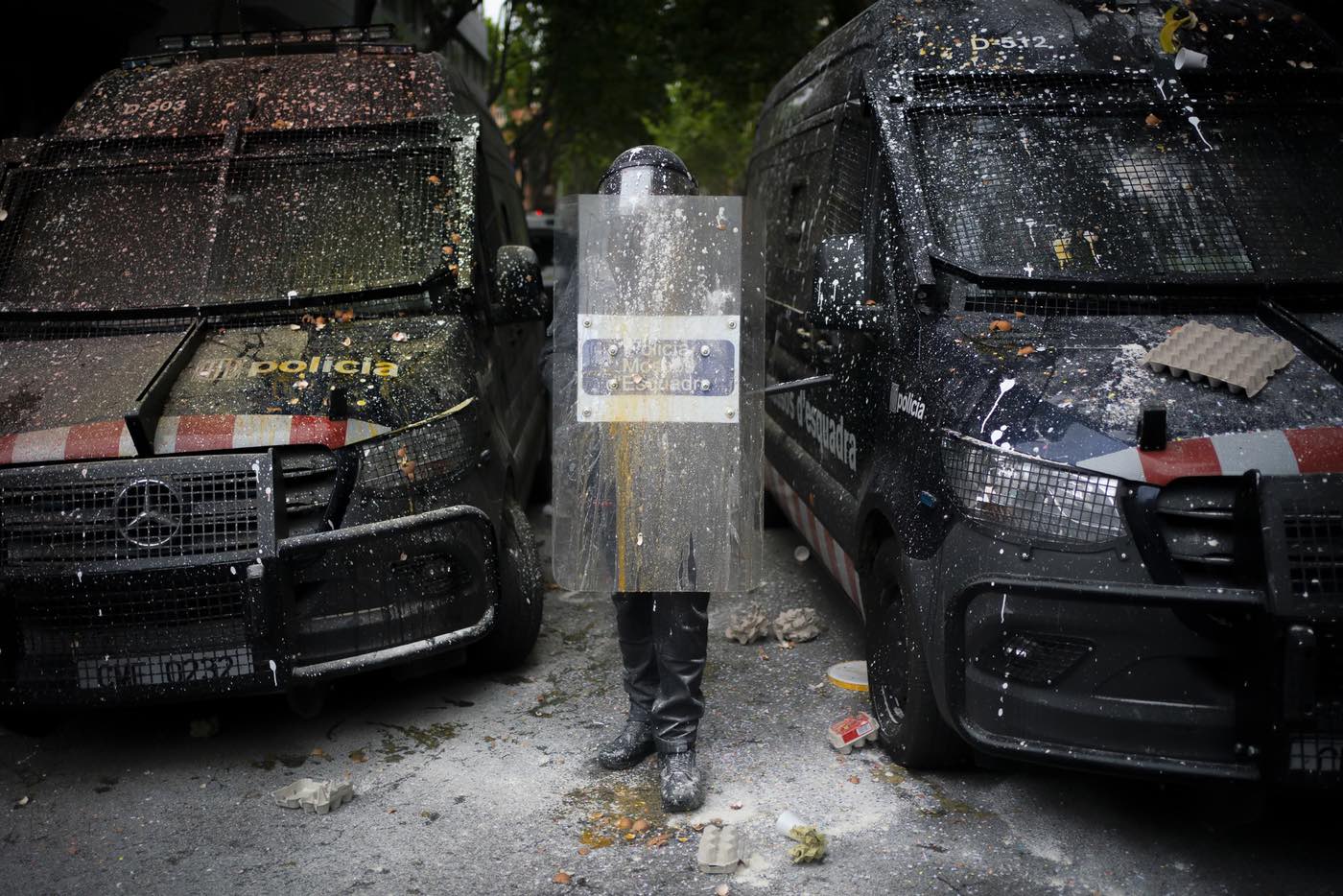
Riot police are covered in eggs and paint while attempting to evict a building in Barcelona, 2021.
The movement that is now swelling across Spain emerged as a result of strong and stable union-style organizations that operate apart from the official institutional structures that are otherwise so present and influential in political life here. These organizations were built to tackle the housing crisis using horizontal and grassroots power, while simultaneously driving widespread and popular mobilizations like those we are witnessing today. These unions are novel in that they don’t involve questions of work directly, but rather address the conditions in which we live. The movement’s most significant antecedents lie in the creation of organizations such as the PAH (Platform for People Affected by Mortgages), the first chapter of which was founded in Barcelona in 2009. Like the more recently created housing organizations, the PAH groups practice what we call “social unionism.”
The premise is simple: an individual problem like a person facing the threat of losing their home is transformed into a collective issue addressed through shared political action. A variety of union-style tactics soon began to emerge, leading to the halting of many imminent evictions.
A group of thirty or so people assembles in front of an apartment in the historic city center as the sun is rising. People cling to one another tightly, locked arm in arm, crowding in front of the door of the building’s entrance while several vans of riot police pull up and park nearby as scheduled. There’s an announcement from a police loudspeaker to the effect that people must disperse, but no one does. Eventually, the cops move in, struggling to pull each person away one by one, until finally everyone has been cleared. In the end, the eviction is successful, but it takes several dozen police and several hours, slowing the pace of evictions and making it ever more costly and difficult for the city to execute them.
Those who took part in the defense are members the neighborhood’s tenants’ union. Afterwards, they head their separate ways, but then see one another again soon at their next meeting, reflect upon how the defense went, and make plans for the next one. Occasionally, they hold public gatherings, putting out folding chairs in a circle in a plaza or street where people from the neighborhood are invited to take turns describing the problems that they experience with their landlords or reflecting on the broader challenges they face. These people are young and old. Some are radicals with a depth of experiences in various social movements; others simply live nearby and don’t want to see their neighbors kicked out of their homes.
Similar scenes are unfolding across Spain with increasing regularity. It is possible to come across eviction defense actions unexpectedly as one goes on a morning walk to buy bread. They are becoming a part of the fabric of everyday life.
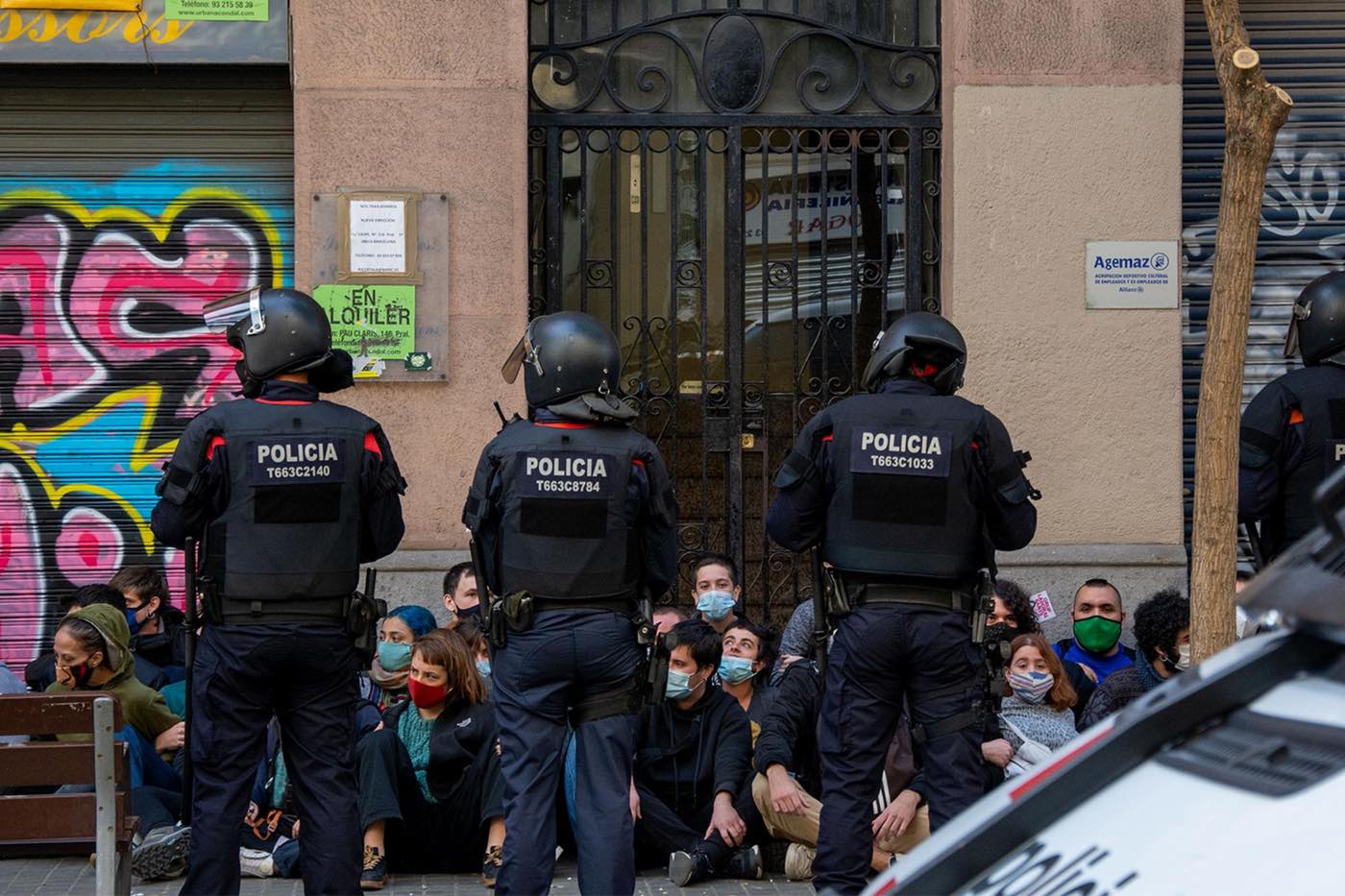
Members of the Tenants’ Union block the front of an apartment building to halt an eviction.
The 2008 crisis shifted the terrain upon which housing organizations operated by drastically transforming the Spanish real estate market. While at first, housing disputes centered on those who had mortgage agreements, changes in legislation and property structures eventually caused struggles around rent to take center stage. Tenants’ unions were founded in Madrid and Catalonia in 2017, a period that also saw the emergence of numerous other housing groups and significant disputes between them. These unions developed new organizing strategies, such as the organization and mobilization of entire apartment buildings and neighborhoods; they focused on organic growth by inviting people to become formal members and attend regular meetings in radical social centers, bookstores, and public spaces. Eviction by eviction, dispute by dispute, block by block: the social explosion of recent weeks is, in reality, the result of this patient work that unfolded over years, addressing a social issue that was bound to erupt sooner or later.
The current housing mobilizations cannot be understood without recognizing the presence of these grassroots organizations, which are the product of a deliberate political strategy by social movement activists—particularly those who come from the autonomous, libertarian, and communist traditions that operate outside of the standard institutional frameworks, which are now widely considered a dead end. This most recent cycle of mobilizations arguably began with a massive demonstration on October 13, 2024 under the slogan “Enough is enough. Let’s lower rents!” The massive scale of that event took many by surprise, including the activists themselves. Since then, other major mobilizations and high-profile evictions have laid the groundwork for the recent social upheaval.
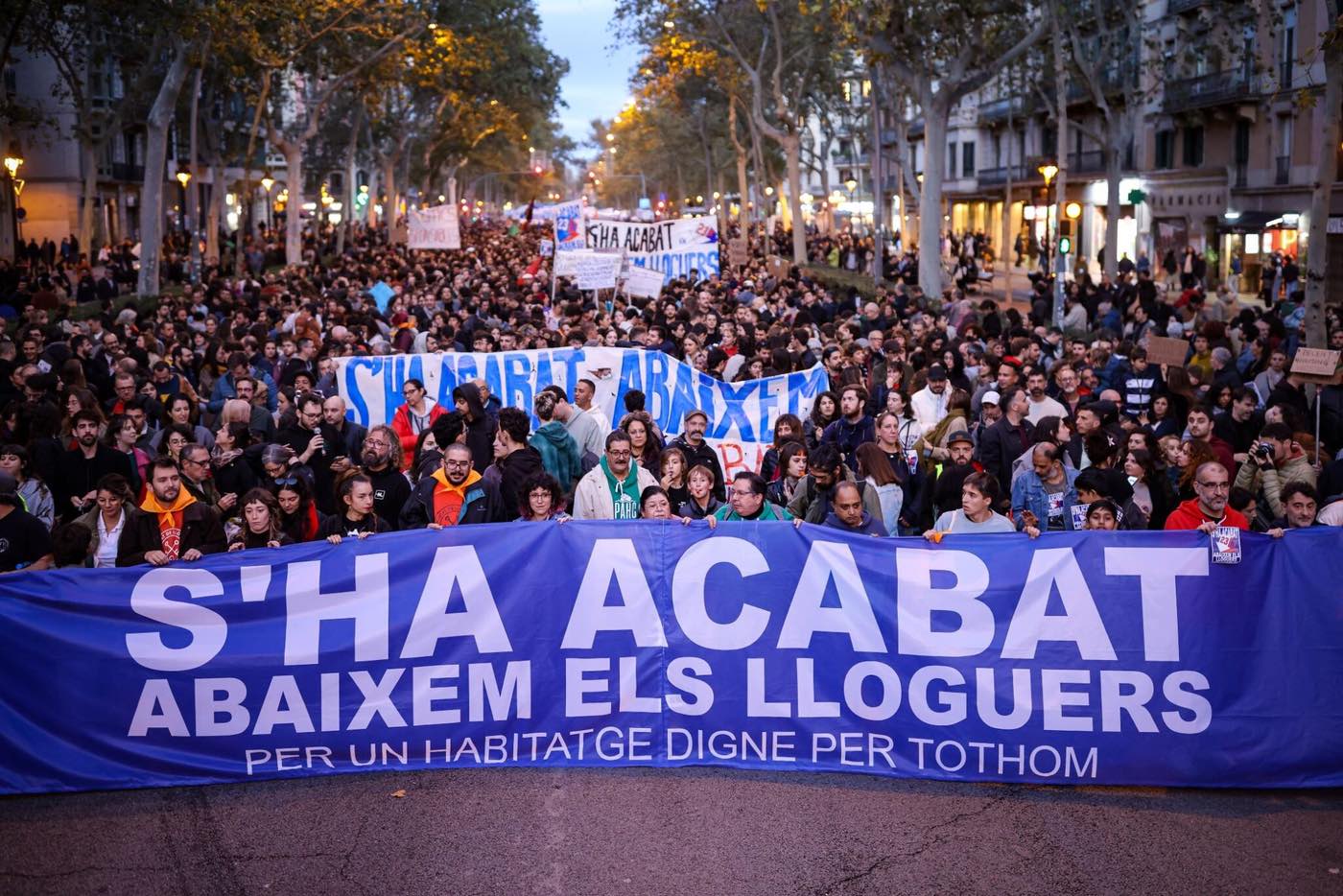
A housing protest takes place in Barcelona in 2024. Its scale surprised even the organizers.
Thousands upon thousands of people pour into the streets. Some carry large banners; others light smoke flares that illuminate the crowd in the evening light and cause them to cheer. Every so often, people take their keys out of their pockets and shake them above their heads, displaying what has come to be symbol of the movement while creating a discordant chorus of metal clanking upon metal. Small groups of people weave in and out of the march with flat pieces of cardboard and cans of spray paint in their hands, decorating the bus stops, bank windows, and walls of the city with messages against the financial “vultures” that prey upon the housing market.
People are awakening to the possibility that this could be something more, something bigger, something with force.
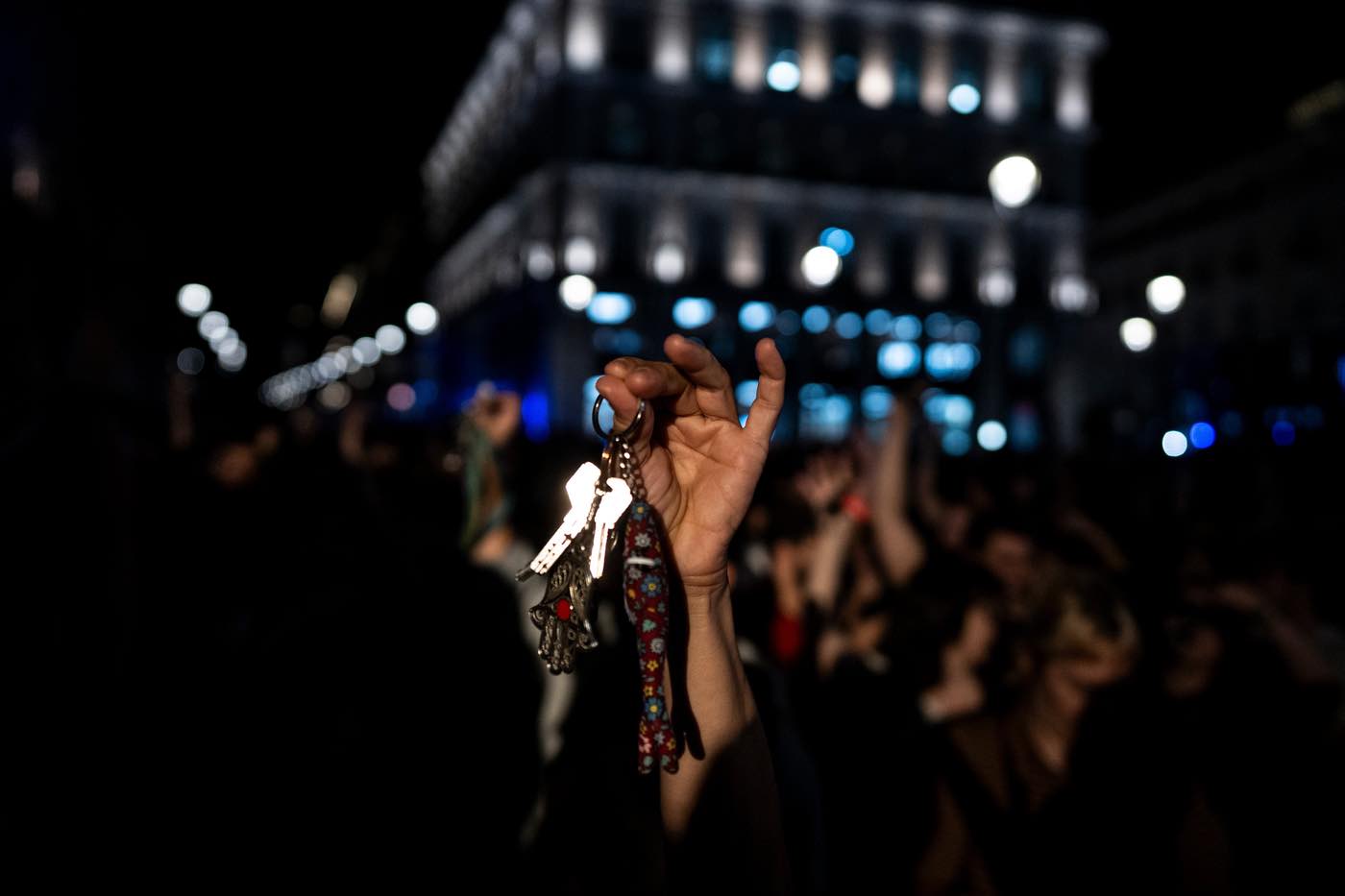
A protester holds up their apartment keys, the symbol of the movement, 2026.
In societies with relatively low economic productivity, such as ours, capital seeks to extract profit from financial markets such as the housing market. This is a systemic phenomenon; people across the globe feel the pressure of it in their daily lives. It takes various forms: neighborhoods rapidly changing, being forced to move because housing has become unaffordable, being compelled to allocate an ever-larger share of their wages to housing costs. One can see organizations similar to our local housing unions in many other countries, as conflict inevitably follows capital wherever it goes.
All of this is palpable in people’s everyday lives. There are other equally important issues, the causes of which can be traced back to capitalism but which may not be so clearly linked to people’s daily experiences—for instance, the rising food prices caused by wars taking place thousands of kilometers away. But being evicted from your home or seeing your neighbor evicted is something very palpable, as it has immediate and tangible consequences.
It is also easy to identify the culprits: everyone knows that they are the police who physically remove people from their homes, the companies or landlords who request such actions, the judges who issue the orders, and the politicians who have created the legal framework that enables this to happen. The key success lies in having framed this as a political and social issue, through housing organizations and the political networks in which they are embedded. A future challenge, though significant work has already been done in this regard, is to link the struggle for housing with other struggles and the various other problems that people face.
As the state recedes as a horizon of political possibility, the potential of another way from below becomes more legible—it can be felt as more attainable and real.
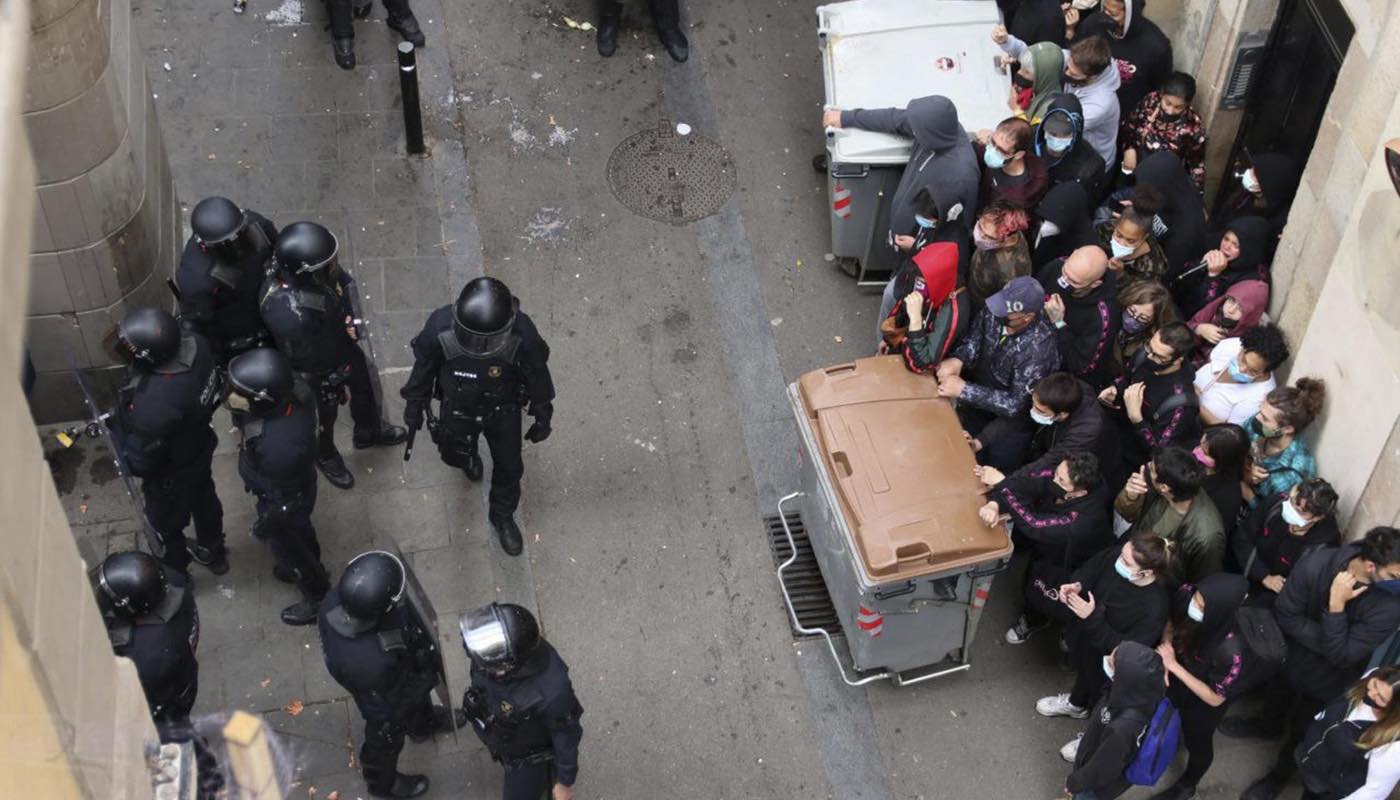
Members of the Tenants’ Union block the front of an apartment building to halt an eviction.
A squatted social center faces eviction under the socialist government in Barcelona, and there is a call to defend the space. It’s a cold January at the opening of the year 2025. Neighbors have used the space for several years as an autonomously organized gym, meeting space, and library, but because it is close to the tourist area of the city, the local politicians want to tear it down. The people who have been active in L’Antiga Massana, named after the art school which previously had its home there, call for a series of demonstrations aiming to halt the eviction, but the police arrive without warning one morning to seal the doors shut.
Large crowds mobilize in the evening in an attempt to take back the building, but armies of police block the way, and the gathering concludes with street fighting throughout the neighborhood with fireworks and flares, until everyone eventually feels like they must call it a night and disperse. Another squatted space is tragically lost, and the city is transformed an inch further into a place not for living, but for shopping and tourism—not for sharing, but for capital.
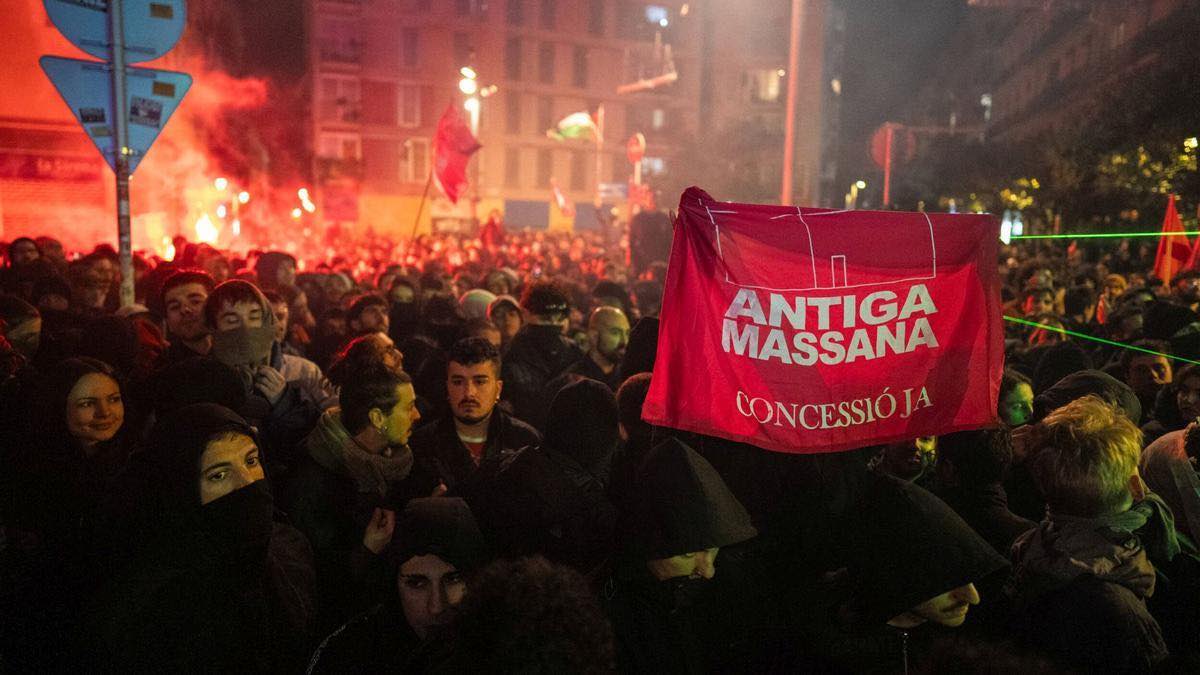
Protesters mobilize to defend the squatted social center L’Antiga Massana, 2025.
In these tumultuous times, our political landscape has changed completely. It has been a total U-turn, one we welcome with great joy and which gives us a new momentum to fight harder and more effectively. We were experiencing a period of relative paralysis, during which we watched helplessly as fascism gained ground in Spain and across Europe. Now, we see the emergence of a massive social force eager to change everything. Suddenly, we are preparing for a general strike, something this country hasn’t seen in over a decade.
This strike, however, is not taking place under the circumstances we had hoped for. Parliament has been dissolved after failing to pass housing relief, and elections will be held on November 29—elections that the progressive media and left-wing parties will seek to frame as a national referendum on housing. The right will try to take advantage of this situation, trying to present the encampments and the government as two sides of the same coin. The socialist PSOE party in power has played its cards well, as it is in a position to capitalize—at least in the eyes of part of the general public—on what was initially a strong wave of protests against the government’s housing policies.
The right and the far right may well win the upcoming elections, or the socialists may survive this moment once again, but all this has shown that regardless of what happens, they will face a mobilized opposition on the streets. An opposition mobilized notony against fascism and the failures of the state, but as an autonomous force intent on securing material improvements for our class.
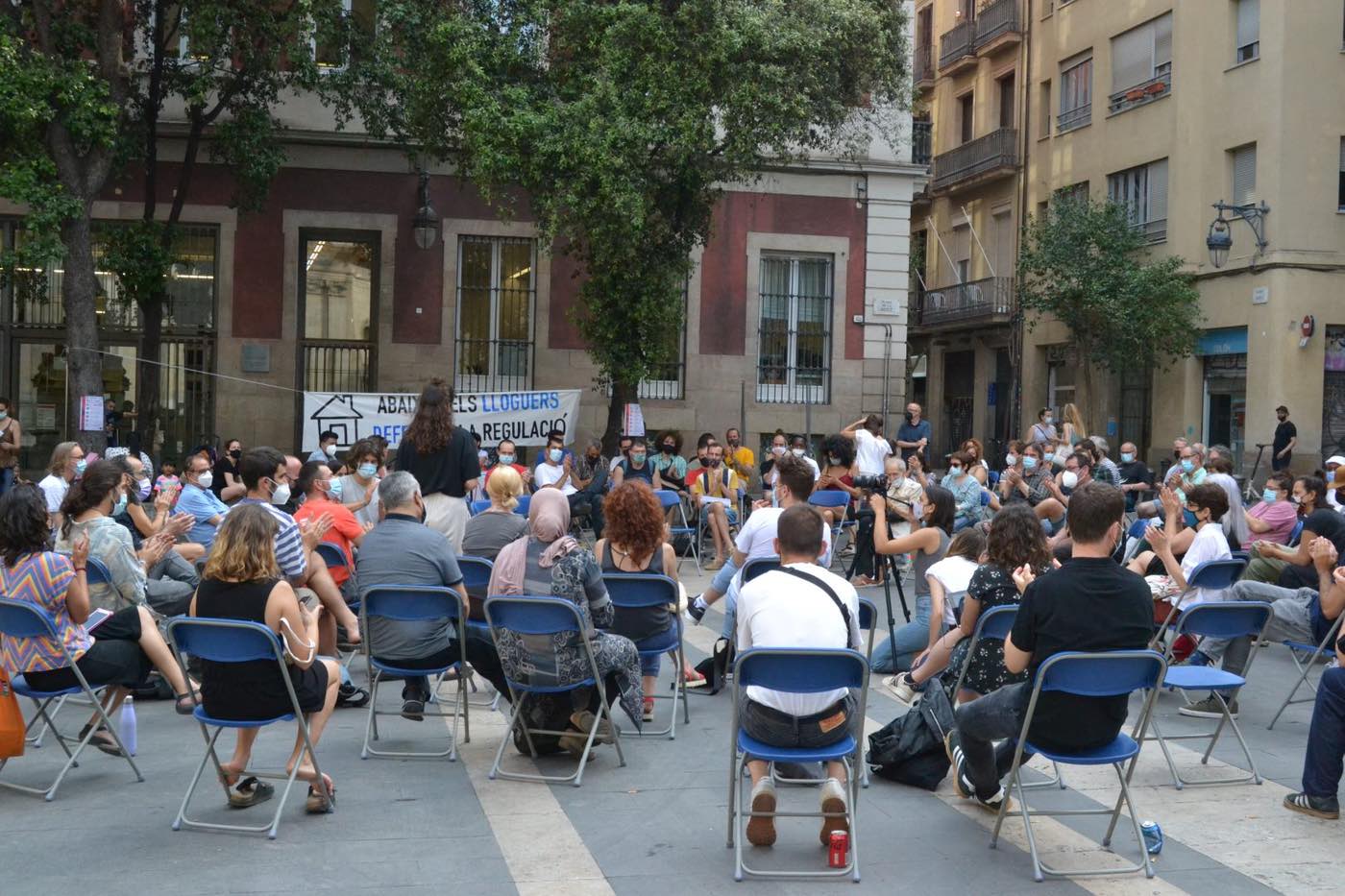
The Tenants’ Union holds a public assembly to organize the neighborhood.
The tenants’ unions continue to develop and grow—organizing within each neighborhood and regularly calling for public meetings, developing forms of solidarity, and reflecting upon their evolving strategies and tactics. These unions draw people together from across the political spectrum, bringing together people from socialist youth groups, independentist political parties, anarchists, and people with less clear political affiliations.
Another flashpoint emerges in Barcelona around Casa Orsola, a large apartment building in the residential area of the city that is home to several families, as speculators attempt to evict it so that it can be converted into short-term rental units. Demonstrations are called in order to defend the space; this draws hundreds of neighbors onto the streets on the day the police are expected to arrive. People of all ages and backgrounds can be seen gathering. Grandparents stand alongside their children and grandchildren in front of the building’s doors, while masked figures dressed all in black stalk the rooftop, ready for whatever might come. After a standoff that lasts all morning, the local government halts the eviction and declares its intention to purchase the building and convert it into public housing.
The local government sides with the movement, for now, hoping thus to bring calm and redirect some of its energy back into institutional frameworks.
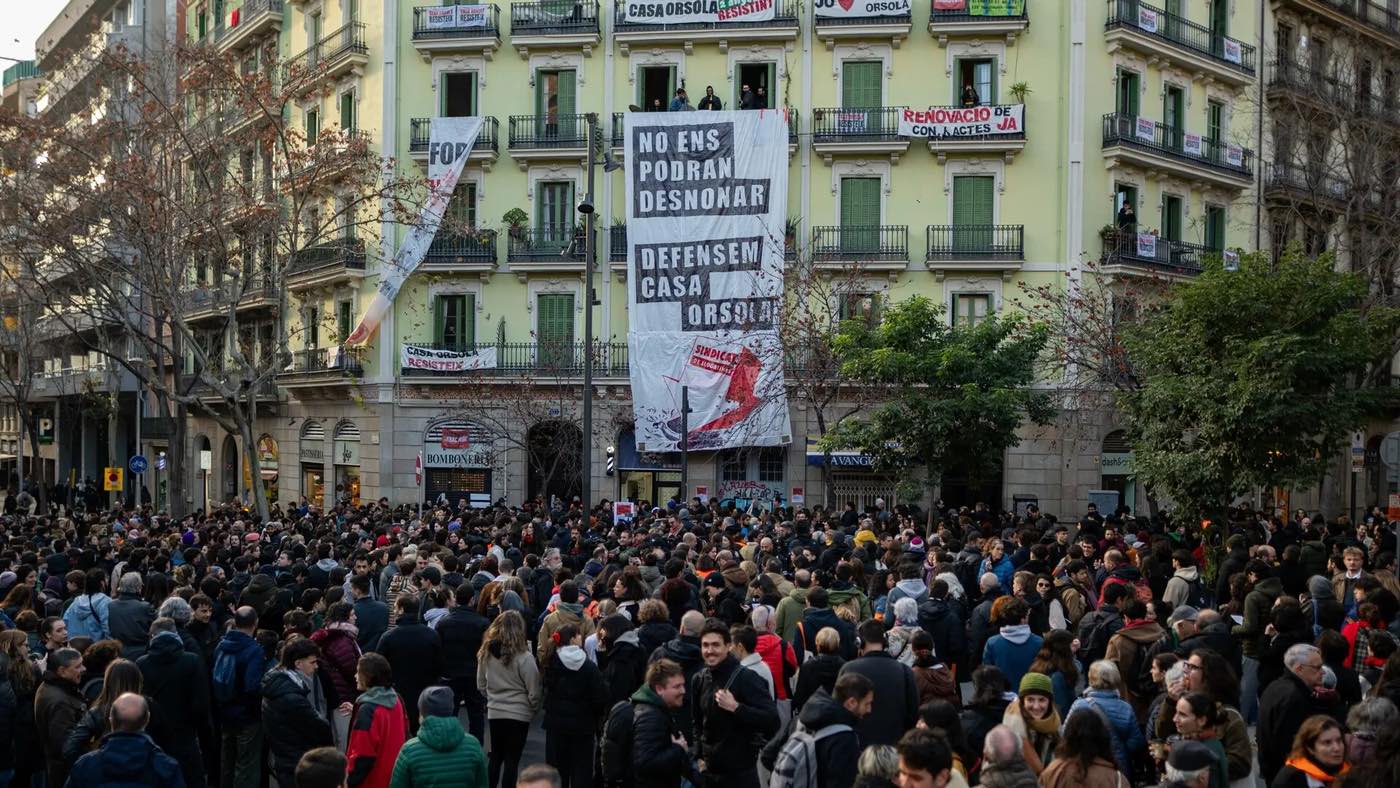
Neighbors gather to defend Casa Orsola, 2025.
As the general strike is organized, there are already several forces that seek to steer it in this or that direction. The CCOO (Comisiones Obreras) and UGT (Unión General de Trabajadores), unions that have historically functioned as state proxies and buffers to suppress social conflict, have already announced that they are supporting the general strike. As the largest unions, their backing was crucial for ensuring strong participation in the strike—though, to an extent, this support was wrested from them, as it is not their natural stance. At the same time, it is equally important to push beyond the pacifying role these unions have played. The CCOO and UGT will seek to channel the strike into forms of civic expression and frame it as “the people” closing ranks with the left wing of the state, a narrative which we must resist.
The encampment and any future mobilizations must struggle to maintain their original spirit of challenging the status quo by opposing the entire parliamentary system, while specifically highlighting the hypocrisy of the progressive government and opposing the housing business and all the capitalist interests that profit from it.
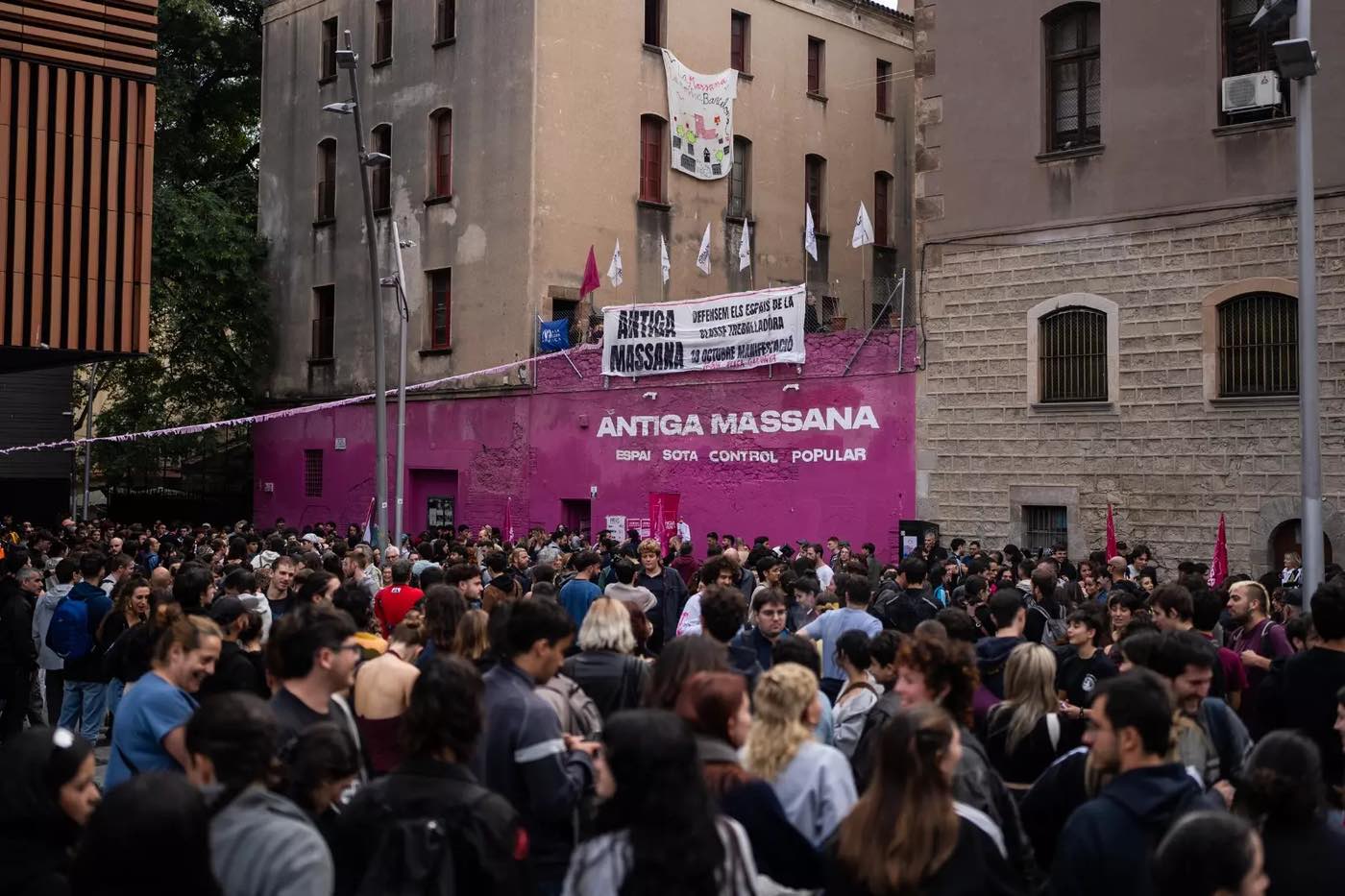
Protesters mobilize to defend the squatted social center L’Antiga Massana, 2025.
The encampments that have spread across the country continue to blossom, building community kitchens, establishing info points to inform people about upcoming events and demonstrations, holding regular meetings and skillshares throughout the day. Occasional threats from far-right fascist groups give rise to anti-fascist demonstrations that defend the camps. The number of tents grows, and grows, and grows.
Various organizations establish themselves in the encampments, but most only last a few days before withdrawing again, confirming the encampment’s autonomous and horizontal form. In Madrid, an eviction is successfully halted after people from the encampment drive the police away. Then, a series of incredibly large demonstrations take place across Spain to build upon the energy of the movement, filling the centers of most large cities. Chants such as “Here are the anti-fascists!” and “A, Anti, Anticapitalista!” and “Long live the struggle of the working class!” suggest a broader horizon than the tenants’ struggle. The demonstration in Barcelona ends in a confrontation with the police, leading to a street battle that involves the improvised assembly of flaming barricades and the liberation of nearby construction materials, which participants throw at riot police and their vans as they retreat.
In the aftermath, people look towards the general strike as a moment to expand the movement and sharpen its intensity. The various groups that had developed to capacity to regularly organize neighborhood meetings around eviction defense now put these skills to use again by holding regular meetings with neighbors to prepare for the strike.
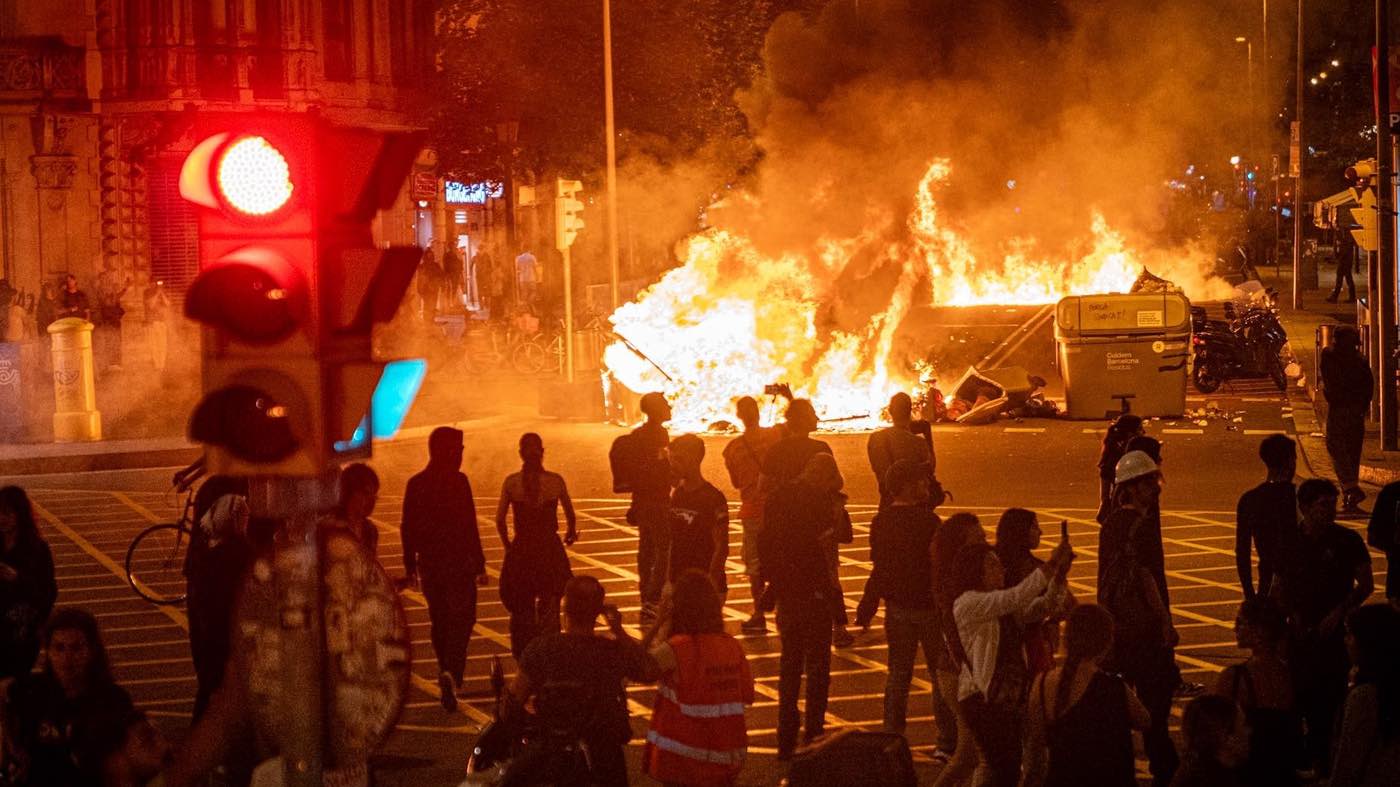
People build barricades after riot police halt a housing demonstration in Barcelona, 2026.
Across Europe, there is new life in the streets. Across France, students are in revolt against a state that has abandoned them. Recently, this revolt has spread to Belgium, and there are early signs of it in Italy—now [Albania’s education ministry has caught fire], and it may go further still.
To break out of the pincer movement in which the progressive government and the CCOO and UGT have trapped us here in Spain, we must ensure that upcoming mobilizations, especially the general strike in November, do not turn out the way they want them to. The streets must not fall in line behind any government. Both our demands and our forms of action must outflank all of these actors from the left, placing them once again in an untenable position. We need to become unacceptable to the institutional left within the state apparatus once more. Otherwise, the window for mobilization that has opened up could close far too soon. The general strike must not become the end of this story, but only one additional chapter, one which we here must struggle to leap past and continue to push beyond.
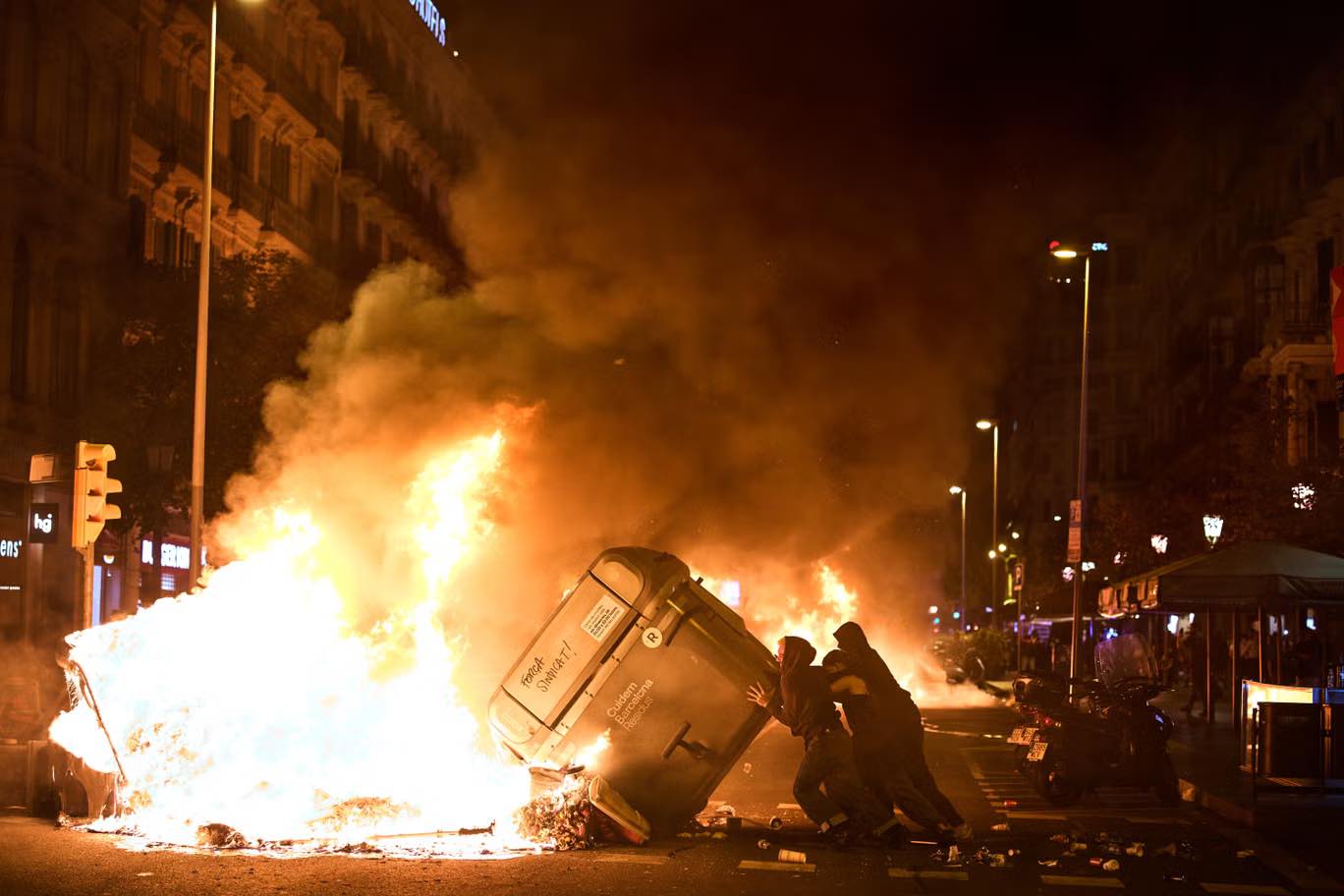
People build barricades after riot police halt a housing demonstration in Barcelona, 2026.
Further Reading
On the current encampment movement:
- The Destituent Question of the Encampments
- And Suddenly, a Jolt: Notes on the Fly from the Puerta del Sol Encampment (in Spanish)
On tenants’ unions and rent strikes: